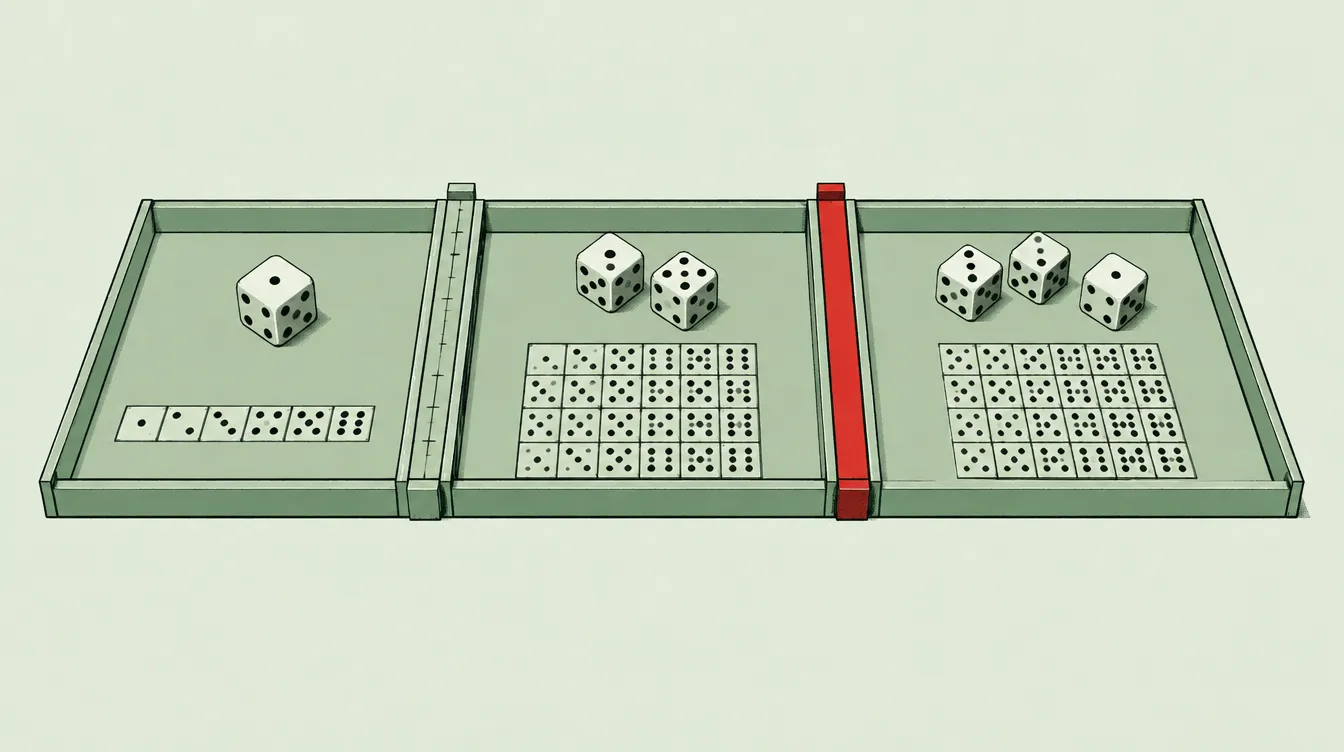
Farkle is a push-your-luck game for two or more players with six dice. On your turn you roll, set aside at least one scoring die, and either bank your points or roll the remaining dice for more. Roll nothing that scores and you “farkle”, losing everything from that turn. The first player past 10,000 points triggers the final round.
Farkle has no single official rulebook, so groups play slightly different scoring. Below are the core rules most people use, the main variants, and the odds that tell you when to keep rolling.
What you need
- Six standard six-sided dice.
- Paper and pencil for a running score per player.
- Two or more players (solo play works as a score-chasing exercise).
The game has relatives under names such as Zilch, Ten Thousand, Greed and Hot Dice, and the same family of rules runs through them all.
How a turn works
- Roll all six dice.
- Set aside scoring dice. You must keep at least one scoring die or combination from this roll. Combinations count only if they appear in a single roll; you cannot build a triple from dice kept on different rolls.
- Bank or continue. Stop and add the turn total to your score, or roll the dice you did not set aside.
- Keep going or farkle. Each new roll must again produce at least one scoring die. If it produces none, you farkle: the turn ends and every point gathered in it is lost.
Hot dice: if all six dice have been set aside as scoring dice, you may pick all six up and roll again, adding to the same running total. There is no limit to how many times this can happen in a turn.
Farkle scoring chart
| Dice combination | Score on this page | Variants you may meet |
|---|---|---|
| Single 1 | 100 | Same everywhere |
| Single 5 | 50 | Same everywhere |
| Three 1s | 1,000 | 300 in some sets, including the commercial Pocket Farkel game |
| Three 2s / 3s / 4s / 5s / 6s | 200 / 300 / 400 / 500 / 600 | Same everywhere |
| Four of a kind | 1,000 | 2,000, or double the three-of-a-kind value |
| Five of a kind | 2,000 | 4,000, or four times the three-of-a-kind value |
| Six of a kind | 3,000 | 6,000 or 10,000, or eight times the three-of-a-kind value |
| Straight 1-2-3-4-5-6 | 1,500 | 1,000 or 3,000 |
| Three pairs | 1,500 | 750 in some published rule sets, 2,000 in others; not scored at all in some groups |
| Four of a kind plus a pair | 1,500 | Often not used |
| Two triplets | Scored as two separate triples | Some groups award a fixed bonus |
The middle column follows the scoring summarised in Wikipedia’s Farkle article; no version is official, so the right-hand column matters as much. Twos, threes, fours and sixes score nothing alone; they count only inside a combination. Agree on the variant column before you start, because it changes how often the big hands appear in the scoring.
Starting and finishing the game
Many groups use an opening threshold: you must bank at least 500 points in a single turn (some groups say 1,000) before any of your scores count. After that, any banked amount is added. A stricter version demands a minimum, such as 300 or 350, on every turn.
When a player’s banked total reaches 10,000 or more, every other player gets one last turn to beat it. Whoever has the highest total after that final round wins. Some groups require the leader to finish with exactly 10,000, or play to a lower target for a shorter game.
A common penalty rule: three farkles in a row cost you points from your banked score, usually 500 or 1,000 depending on the rule set.
Worked turns
Turn 1: a cautious bank
You roll 1-3-4-4-5-6. Scoring dice: the 1 (100) and the 5 (50). Keeping both leaves four dice; keeping only the 1 leaves five. You keep just the 1 (100) to roll five dice, which farkle far less often. Next roll: 2-2-2-3-6. The three 2s score 200, total 300, two dice left. Rolling two dice farkles about 44% of the time, so with 300 in hand most players bank (if they have already met the opening threshold).
Turn 2: hot dice
First roll: 1-1-5-5-3-3. Under the chart on this page that is three pairs for 1,500 (750 in some rule sets), using all six dice. Hot dice: you roll all six again with 1,500 riding. The next roll is 2-3-4-6-6-2, which has no 1, no 5 and no triple. Farkle: the 1,500 is gone. Whether to roll on hot dice is a judgement call, but six dice farkle only about 2% of the time, so most players do.
Turn 3: building with triples
You roll 4-4-4-1-2-6. Keep the three 4s (400) and the 1 (100): 500, two dice left. Instead you could keep only the 4s, roll three dice, and hope for more. With 500 on the line and the threshold met, banking is the standard play.
Odds of farkling
A roll farkles when it contains no 1, no 5 and no scoring set. Counting every outcome gives these chances for the chart on this page:
| Dice rolled | Possible outcomes | Chance of a farkle | Chance of scoring |
|---|---|---|---|
| 1 | 6 | 66.67% | 33.33% |
| 2 | 36 | 44.44% | 55.56% |
| 3 | 216 | 27.78% | 72.22% |
| 4 | 1,296 | 15.74% | 84.26% |
| 5 | 7,776 | 7.72% | 92.28% |
| 6 | 46,656 | 2.31% | 97.69% |
The six-dice figure assumes three pairs score. If your group does not count three pairs, a six-dice farkle rises to about 3.09%.
When to bank: practical guidance
The odds above point to a simple pattern. With five or six dice left, rolling is nearly always right, since you farkle less than 8% of the time. With four dice, keep going unless you already hold a big total. At three dice the risk is more than one in four, and at one or two dice it approaches or exceeds even.
So a widely used rule of thumb is: bank 300 or more when only one or two dice remain, bank around 400 to 500 with three dice, and push on with four or more unless the turn total is large. Adjust for the scoreboard. Trailing late in the game, you need to take more risk; leading comfortably, bank smaller totals and let others chase.
Also think about which scoring dice to keep. Setting aside every 5 you roll adds 50 points each but costs you dice for the next roll. Keeping a single 1 and rerolling five dice often beats keeping 1-5-5 and rerolling three.
Farkle and other dice games
Farkle shares the “keep some, reroll the rest” idea with Yahtzee, but the decision is different: in Yahtzee you fill boxes, in Farkle you weigh points in hand against the chance of losing them. Our dice games hub covers the probability behind both, and pages on craps and sic bo show the same counting method applied to two and three dice.
Farkle questions
How many dice are used in Farkle?
Six standard dice. Each turn starts with all six, and you roll fewer as you set scoring dice aside, unless you score with all six and get hot dice.
Do three pairs score in Farkle?
In most six-dice rule sets, yes, but the value varies: 1,500 on the chart on this page, 750 or 2,000 in other published sets. Five-dice versions cannot have them at all, so agree before you start.
Can you combine dice from different rolls into a triple?
No. A combination only counts if all its dice come up in the same roll. Two 4s kept earlier plus a 4 rolled later do not make three 4s.
What happens when someone reaches 10,000?
Each other player gets one final turn to beat that total. The highest banked score after the final round wins.
What is the chance of farkling on the first roll?
About 2.31% with six dice when three pairs score, or roughly 1 roll in 43. If three pairs do not score, it is about 3.09%.
Sources
- Wikipedia: Farkle (rules and scoring variants)en.wikipedia.org
- Pocket Farkel FAQ (archived)web.archive.org
Checked against these sources on 7 Oct 2026. Found an error? Send a correction.