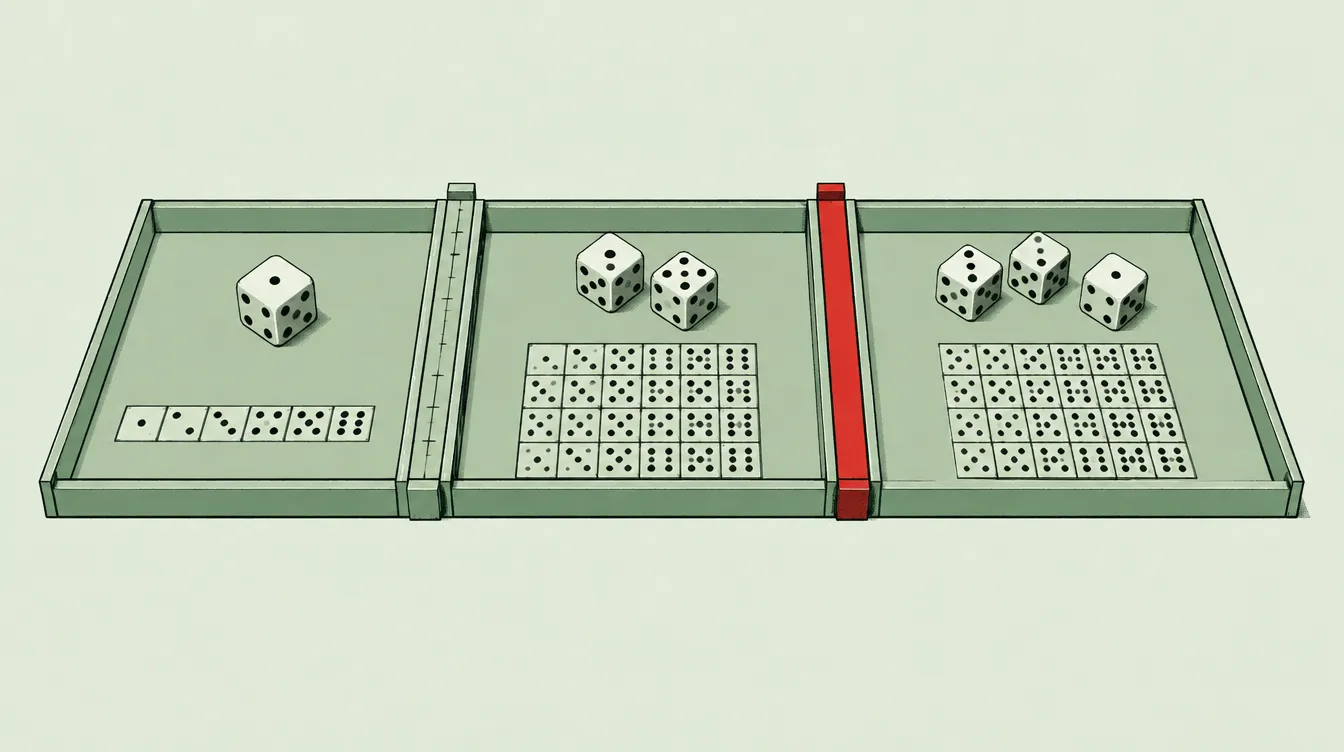
Sic bo is a three-dice game where you predict the result of a single shake: a high or low total, an exact sum, a particular number or a pair or triple. One shake settles every wager on the table, and there are no decisions after the roll. The cheapest bets are Small and Big, with a house edge of 2.78%; the rest of the layout ranges up to around 19% on common paytables, and worse on some.
Below you will find the layout explained area by area, the probabilities behind every bet, the paytable differences that change the maths, and a few worked examples.
Where sic bo comes from and how a round works
Sic bo is a Chinese game. Its name is commonly translated as “precious dice”, and Cantonese speakers also call it dai siu or tai sai, meaning “big small”, after its most popular wager. Casinos in Asia have dealt it for decades, and online studios now stream it worldwide.
A round has three steps:
- Bets open. You place chips on any areas of the layout, as many as you like, within the table limits.
- The dice are shaken. A dealer agitates three dice in a covered shaker or a mechanical dome; RNG games produce the result in software.
- Results light up. Every winning area is highlighted, winners are paid and losing chips are cleared. Then betting reopens.
A live round takes around a minute, while an RNG round can be finished in a few seconds. Speed matters for your budget, as the examples further down show.
The maths in one line: 216 equally likely rolls
Three six-sided dice can land 6 x 6 x 6 = 216 ways. Each of those ordered results is equally likely, so every sic bo bet has an exact probability: count the winning results and divide by 216. Compare that with the payout and you have the house edge.
Two counts drive most of the layout. There are 6 triples (1-1-1 up to 6-6-6), so a triple appears on about 2.78% of rolls. Outcomes with exactly two matching dice number 90, and the remaining 120 show three different faces.
The layout, area by area
Small and Big
Small wins on totals 4 to 10, Big on 11 to 17. Each covers 105 of the 216 results and pays even money. The catch: both lose when any triple lands, even 2-2-2 (total 6) or 5-5-5 (total 15). Those six triples are the entire house edge on these bets, 6 in 216, which is 2.78%.
Odd and Even work the same way on the parity of the total, also losing on triples. Some online tables offer them, many land tables do not. Their edge is also 2.78%.
Totals
The long row of numbers from 4 to 17 lets you bet on an exact sum. Totals in the middle are common and pay little; the extremes are rare and pay a lot. Totals are symmetric: 4 and 17 have the same chance, as do 5 and 16, and so on.
| Total | Rolls that make it (of 216) | Chance per roll | Payout that would be fair | Payout often offered | Edge at that payout |
|---|---|---|---|---|---|
| 4 or 17 | 3 | 1.39% | 71 to 1 | 60 to 1 | 15.28% |
| 5 or 16 | 6 | 2.78% | 35 to 1 | 30 to 1 | 13.89% |
| 6 or 15 | 10 | 4.63% | 20.6 to 1 | 17 to 1 | 16.67% |
| 7 or 14 | 15 | 6.94% | 13.4 to 1 | 12 to 1 | 9.72% |
| 8 or 13 | 21 | 9.72% | 9.3 to 1 | 8 to 1 | 12.50% |
| 9 or 12 | 25 | 11.57% | 7.6 to 1 | 6 to 1 | 18.98% |
| 10 or 11 | 27 | 12.50% | 7 to 1 | 6 to 1 | 12.50% |
The last column is the average slice of each stake that stays with the house after many rolls. Total 7 or 14 is the least costly sum on this paytable; 9 or 12 is the most costly, even though 9 and 12 are among the most frequent totals.
Single number (one die face)
Pick a face from 1 to 6. You win if it appears on at least one die, and the payout rises with the number of matches. The usual paytable is 1 to 1 for one match, 2 to 1 for two and 3 to 1 for three.
Here is how that prices out. Of the 216 rolls, 75 show your number once, 15 show it twice and 1 shows it three times; the other 125 miss. At 1-2-3 the return is (75 x 2 + 15 x 3 + 1 x 4) / 216 = 199/216, leaving an edge of 7.87%. A table paying 12 to 1 for three matches instead of 3 to 1 gets that down to 3.70%, so the triple payout is worth checking.
Many players expect this bet to win half the time because there are three dice and six faces. It does not: the chance of at least one match is 91 in 216, about 42%.
Two-dice combinations
These 15 boxes each show two different faces, such as 1 and 4. You win if both appear among the three dice. Thirty of the 216 rolls do that, and the usual 5 to 1 payout leaves an edge of 16.67%.
Specific double
Choose a face; you need at least two dice showing it. Sixteen rolls qualify (15 with exactly two, plus the triple). At 10 to 1 the edge is 18.52%. Older tables paying 8 to 1 push it to 33.33%, a third of every bet.
Any triple and specific triple
Any triple wins on all six triples, 6 rolls in 216. At 30 to 1 the edge is 13.89%; at 24 to 1 it climbs to 30.56%. A specific triple (say three 4s) has one winning roll in 216. At 180 to 1 the edge is 16.20%; at 150 to 1 it is about 30%.
Every sic bo bet on one sheet
The totals have their own table above. This one covers the rest of the layout, with the payout you will meet most often and a weaker version that still turns up on older or land-based tables.
| Bet | Winning rolls of 216 | Chance | Usual payout (edge) | Weaker payout seen (edge) |
|---|---|---|---|---|
| Small, Big, Odd, Even | 105 | 48.61% | 1 to 1 (2.78%) | none, always even money |
| Single number | 91 | 42.13% | 1/2/3 to 1 (7.87%) | 1/2/12 to 1 is better (3.70%) |
| Two-dice combination | 30 | 13.89% | 5 to 1 (16.67%) | rarely varies |
| Specific double | 16 | 7.41% | 10 to 1 (18.52%) | 8 to 1 (33.33%) |
| Any triple | 6 | 2.78% | 30 to 1 (13.89%) | 24 to 1 (30.56%) |
| Specific triple | 1 | 0.46% | 180 to 1 (16.20%) | 150 to 1 (30.09%) |
Notice how the edge more than doubles on doubles and triples when the payout drops by just a few units. A table with weak triple payouts is worth skipping even if you only play those bets now and then.
Paytables differ, so the edge differs
Sic bo has no single global paytable. Two tables can look identical and pay quite differently on the same spot. The Wizard of Odds lists many versions, with Total 4 alone paid anywhere from 50 to 1 up to 65 to 1. A single unit of payout on a rare result moves the edge by several points.
Three checks before you play:
- Open the help screen or the paytable icon. Online games state each payout and often a return-to-player figure per bet.
- Compare the long shots. The triple, double and total-4 payouts vary most between versions.
- Look for “for” versus “to”. “61 for 1” includes the stake and equals 60 to 1.
Where a game publishes RTP per bet, house edge is simply 100% minus that figure. A Small bet at 97.22% RTP matches the 2.78% worked out above, which is a quick way to confirm the paytable is standard.
Worked examples
Covering several bets on one roll
Suppose you stake 2 mBTC on Big, 0.5 mBTC on Total 14 and 0.5 mBTC on the single number 5, a 3 mBTC round. The dice show 5-5-4, a total of 14.
- Big wins 1 to 1: +2 mBTC.
- Total 14 wins 12 to 1: +6 mBTC.
- Single number 5 appears twice and pays 2 to 1: +1 mBTC.
Net result: +9 mBTC on that roll. If the dice had shown 4-4-4 instead, the total of 12 is “Big” by sum but the triple kills it, so all three bets would have lost 3 mBTC.
What a session costs on average
Take 400 rounds at 1 USDT on Small: 400 USDT of action at 2.78% costs about 11 USDT on average. Move that action to Total 9, paid at 6 to 1, and the expected bill rises to about 76 USDT. Put it on a specific double at 8 to 1 and the expected cost is about 133 USDT. Actual sessions swing well above and below these averages; the edge tells you where they land over many rounds.
Why speed matters
A live table that deals 60 rounds an hour at 5 USDT on Small puts 300 USDT through a 2.78% edge: about 8.3 USDT per hour on average. An RNG version played at 300 rounds an hour turns the same stake into 1,500 USDT of action and roughly 42 USDT per hour. Same bet, same edge, five times the cost.
Can you hedge your way to a profit?
Covering both sides feels safe, but it only guarantees a loss on triples. Bet 5 USDT on Small and 5 USDT on Big: on 210 of 216 rolls one side wins 5 and the other loses 5, so you break even. On the six triples both lose, costing 10 USDT. The average cost per round is 10 x 6/216, about 0.28 USDT, exactly 2.78% of the 10 USDT staked.
Adding an any-triple bet as “insurance” does not fix it either. A 0.5 USDT triple bet at 30 to 1 returns 15 USDT when a triple lands, more than the 10 USDT lost on Small and Big, but it loses 0.5 USDT on the other 210 rolls. Every component keeps its own edge, so the combined bet still costs money on average; you have only changed the shape of the swings.
How long a bankroll lasts
Even-money sic bo bets swing roughly one stake per round, so short-term results are driven by luck far more than by the edge. Over 100 rounds of 1 USDT on Big, the expected loss is about 2.78 USDT, but finishing anywhere between 20 USDT down and 15 USDT up is ordinary. The edge only takes over across thousands of rounds.
That suggests two practical rules. First, size each bet so that a run of 20 losses in a row would not end your session; for a 100 USDT bankroll that means about 5 USDT or less on Small or Big. Second, decide in advance when you stop, both after a loss and after a win, because the long-run average always pulls towards a loss of 2.78% of everything you bet.
Reading the results board
Most live and RNG tables show the last 20 or so results, often with colour-coded Small/Big runs and a frequency chart of totals. The board is a record, not a forecast. A streak of eight Bigs does not make Small more likely on the next shake; the chance remains 105 in 216 for each side. Use the board to confirm how a recent bet settled, and ignore it when choosing the next one.
Live sic bo and multiplier versions
Live studios stream a mechanical shaker with a host and a betting timer. Some versions add random multipliers. Evolution’s Super Sic Bo, launched in April 2019, picks random spots before each roll and boosts them, as high as 1,000x. Pragmatic Play later released Mega Sic Bo, a live title built around a similar random-multiplier mechanic.
Multipliers are funded by lower base payouts on the spots that are not boosted, so a Total or triple bet without a multiplier pays less than on a classic table. The long-run return can stay close to standard, but the results are far more volatile, with longer dry spells broken by rare large wins. If you mainly play Small and Big, check whether those bets are left at even money in the variant you choose.
Strategy: what the dice allow
Every sic bo bet has a fixed negative expectation, and no staking pattern changes that. Doubling after losses on Small or Big (the Martingale) fails the first time a long losing run meets the table limit. Watching the results board for “due” totals does not help either, because three dice carry no memory between shakes.
A few habits do lower the cost of play:
- Keep most of your stake on Small, Big, Odd or Even.
- Use totals 7 and 14 (or 10 and 11) if you want a higher-paying bet with a moderate edge.
- Treat doubles, triples and two-dice combinations as small side bets.
- Choose tables with better payouts on the bets you actually make.
- Slow down: fewer rounds per hour means a lower average cost per hour.
Sic bo with crypto
Crypto casinos run the same sic bo games as other online casinos, from RNG studios and live providers, and simply settle your balance in a coin. Limits are usually quoted in dollars or euros, so the coin amount needed for a minimum bet changes as prices move.
Third-party sic bo is certified for the casino’s licence but is not provably fair in the crypto sense: you cannot check each roll yourself. Our guide to provably fair dice explains the seed-based checks used by in-house crypto games. Bonus terms deserve a look too, as many casinos weight live and table games at a low rate or exclude them from wagering altogether.
No casino is named here for sic bo: when we looked, the lobbies of the sites we review did not let us verify a sic bo table from outside an account. Our casino reviews cover banking, limits and licences, and you can check each lobby’s table and live sections yourself.
Sic bo next to other dice games
| Game | Dice | Cheapest common bet | Its house edge | Decisions after the bet |
|---|---|---|---|---|
| Sic bo | Three | Small or Big | 2.78% | None |
| Craps | Two | Pass line with odds | under 1.41% | Add odds, come bets |
| Crypto dice | One random number | Any target | often 1% | None |
Our craps rules page shows how odds bets bring the craps edge below 1%, and how to play Bitcoin dice covers the single-roll crypto game. For dice games with no money at stake, see Yahtzee.
You must be at least 18 to play sic bo for money, and some countries set a higher age. Set a budget before the session starts. Free, confidential support, including Gambling Therapy and Gamblers Anonymous, is listed on our safer gambling page.
Sic bo questions answered
Why do Small and Big lose on a triple?
That rule is where the casino’s edge comes from. Without it, Small and Big would be fair even-money bets. The six triples make up 6 of the 216 possible rolls, which is a 2.78% edge.
What is the chance of rolling a triple in sic bo?
There are six triples among 216 possible rolls, so any triple appears about once every 36 rolls (2.78%). A specific triple, such as three 6s, appears once in 216 rolls on average.
Which sic bo total gives the best value?
On the common paytable, totals 7 and 14 at 12 to 1 have the lowest edge among the totals, about 9.72%. They are still far more expensive than Small or Big at 2.78%.
How often does a single number win?
A chosen face appears on at least one of the three dice in 91 of 216 rolls, about 42% of the time. It shows on two dice in 15 rolls and on all three in just one.
Are multiplier sic bo games better value?
Not usually. Random multipliers are paid for by lower base payouts on the spots without a multiplier, so the long-run return stays close to standard while the swings get much larger.
Is sic bo the same as craps?
No. Sic bo uses three dice and settles every bet on one roll. Craps uses two dice, has bets that run over several rolls, and offers an odds bet with no house edge.
Sources
- Wizard of Odds: Sic Bo (paytables and house edge)wizardofodds.com
- InterGame: Evolution Gaming launches Super Sic Bo (April 2019)intergameonline.com
- InterGame: Pragmatic Play launches Mega Sic Bointergameonline.com
- Gambling Therapygamblingtherapy.org
Checked against these sources on 7 Oct 2026. Found an error? Send a correction.